
OEM vs ODM Smart Light Switches: Which Is Best for Your Brand?
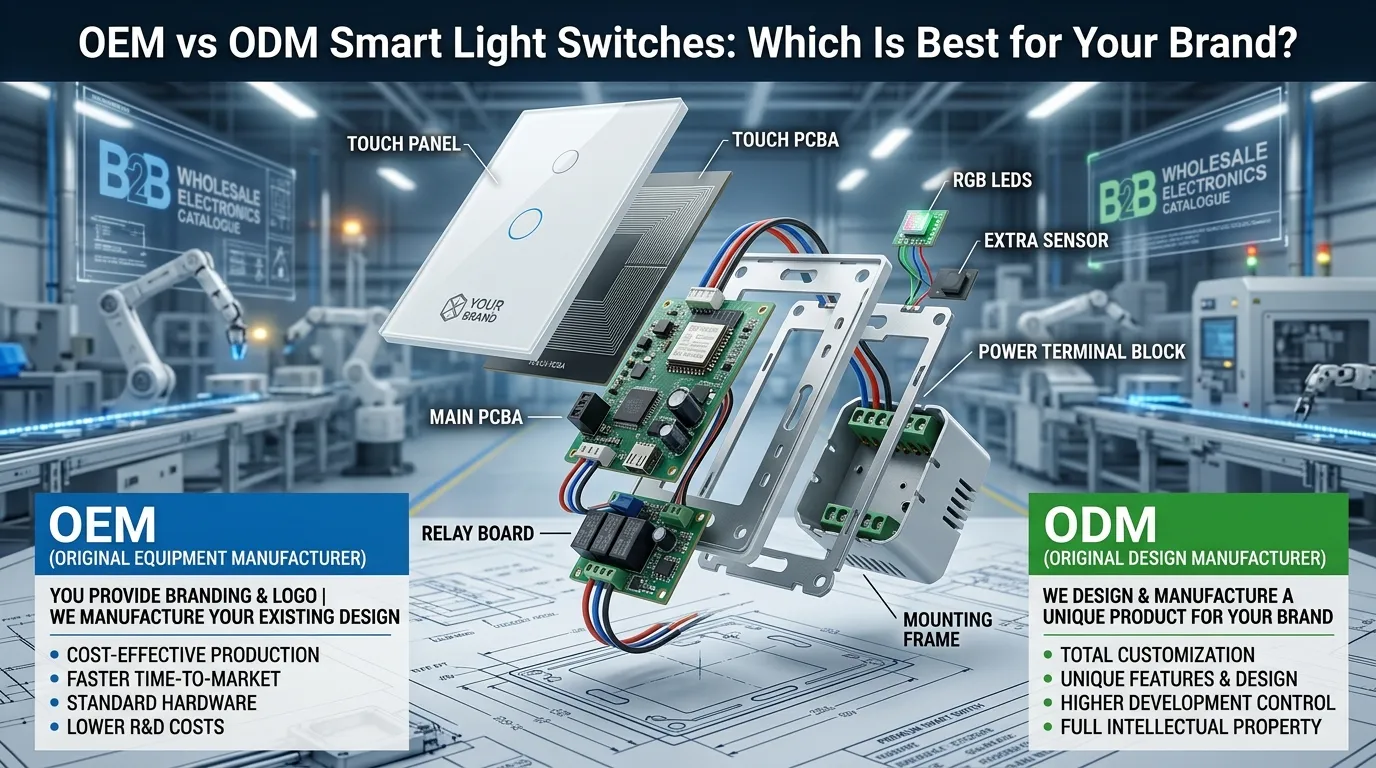
OEM vs ODM Smart Light Switches: Navigating Factory Negotiations
When an electronics retailer or corporate integrator decides to source a new line of smart home gear from mainland factories, finalizing the specific manufacturing pathway dictates upfront capital expenditure and long-term IP ownership. Understanding the nuances between an OEM smart light switch and an ODM relationship is the single most critical decision you will make in product development.
The OEM Pathway: Original Equipment Manufacturer
In an OEM arrangement, the buyer completely controls the intellectual property. You deliver extensive CAD blueprints, PCB layout schematics, and rigorous software UI demands. The factory essentially rents out their pick-and-place machines and molding presses to construct your distinct physical vision.
- Pros: Absolute market exclusivity. Nobody else has your physical form factor, shielding your margins against price-wars.
- Cons: Exponential upfront costs. Injecting custom steel tooling molds for the plastic chassis can cost tens of thousands of dollars and trigger 6-to-9 month incubation periods before full-scale production begins.
The ODM Pathway: Original Design Manufacturer
ODM logic flips the script. The factory dictates the structural enclosure because they have already spent the R&D capital engineering, testing, and mass-producing a perfected smart light switch. B2B buyers purchase these "white-label" devices and customize superficial layers.
- Pros: Immediate speed to market. Importers capitalize on thousands of hours of pre-existing quality assurance testing. Customization is cheap: replacing the laser-etched glass logo, changing the outer retail blister packaging, and perhaps requesting an alternative cloud-backend integration.
- Cons: You might see identical switch bodies carrying different competitor labels in hardware stores.
Strategic Procurement Table
| Parameter | OEM Model | ODM (White Label) Model |
|---|---|---|
| Time to Market | 6-9 Months | 1-3 Weeks |
| Intellectual Property | Buyer Retains 100% | Factory Retains Hardware IP |
| Required Investment | Massive (Tooling/NRE Fees) | Low (Minimal MOQ Requirements) |
Deciding between OEM and ODM relies on your capital runway. At E.T HOME, we offer state-of-the-art ODM stock ready to be branded, alongside massive in-house tooling capabilities for bespoke OEM partnerships. Connect with our supply chain engineers to assess which model fits your corporate trajectory.